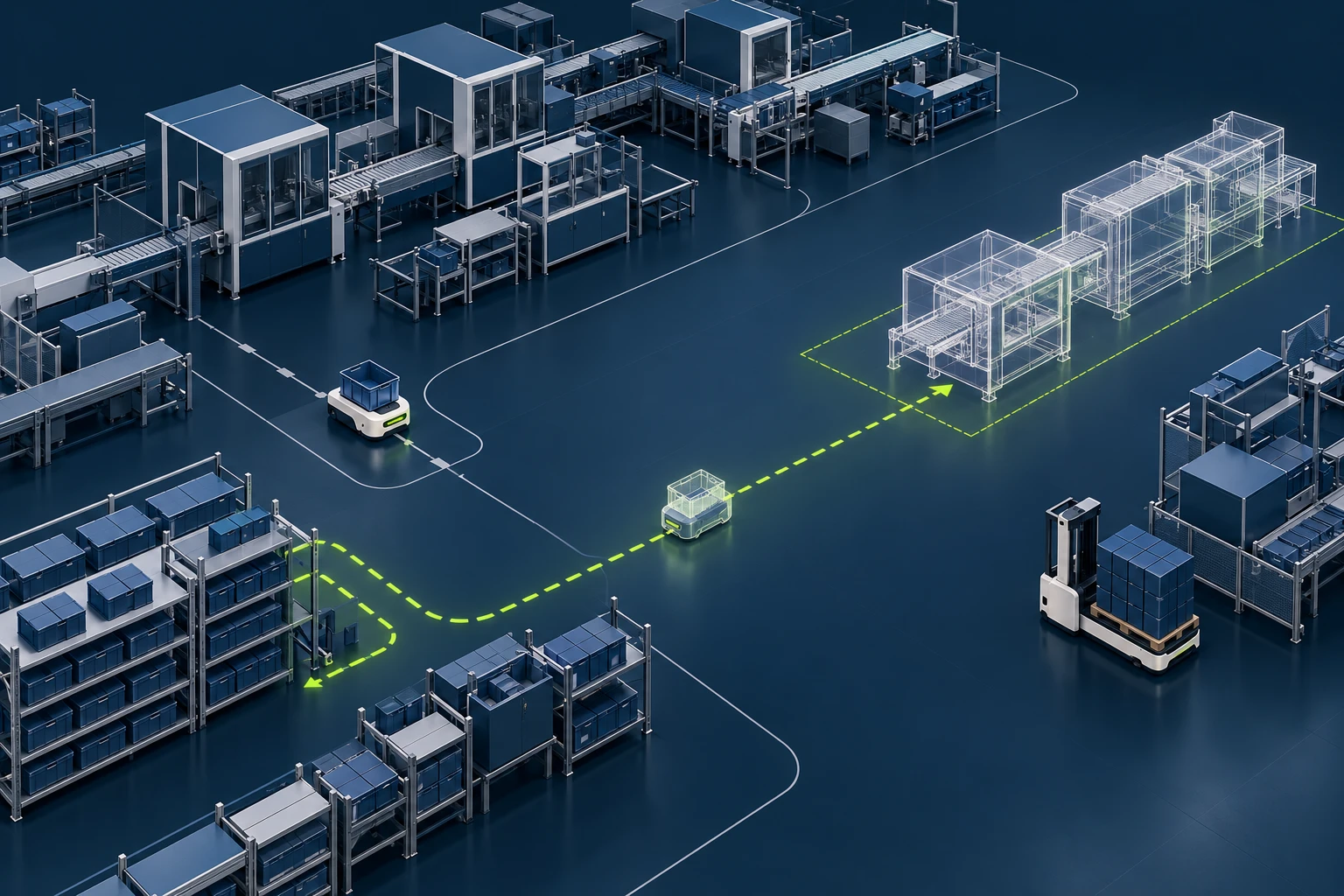
openmaind fleet orchestrator

One interface for all your AGVs and AMRs.

Orders, routes and bottlenecks of your connected mobile robots at a glance – even when they come from different manufacturers. And when something needs to change, simply describe it in your own words.

  • Cross-manufacturer instead of isolated robot islands
  • Natural language instead of complicated operation
  • From the first process to a growing fleet
Block an aisleTry it
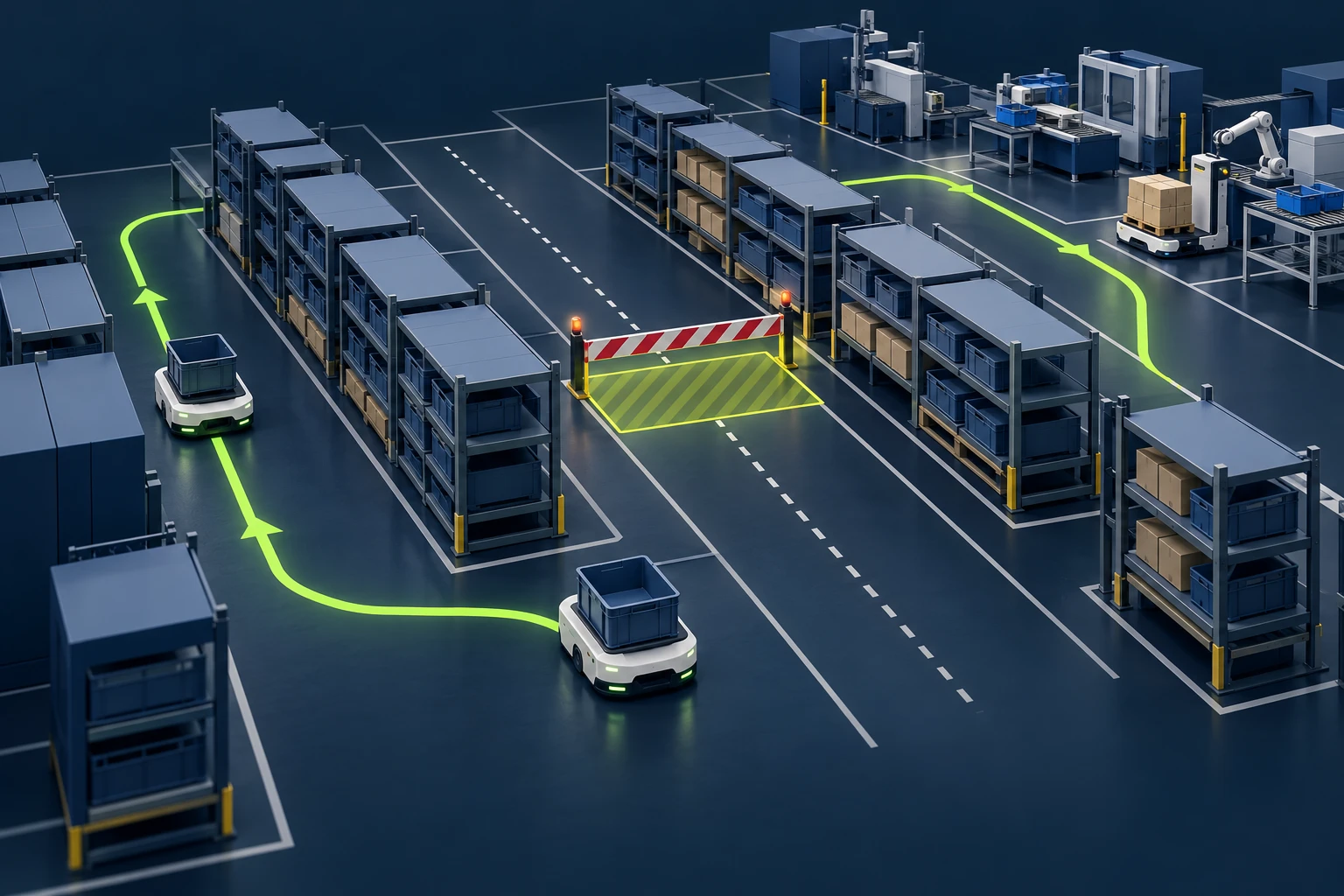
Illustration: An aisle is blocked by a barrier, robots take an alternative route
Block this aisle until 2:00 pm.
LORIopenmaind's AI
I'm blocking the aisle until 2:00 pm and rerouting the robots via the alternative route. Please note: this may change throughput in material supply.
Understand a bottleneckTry it
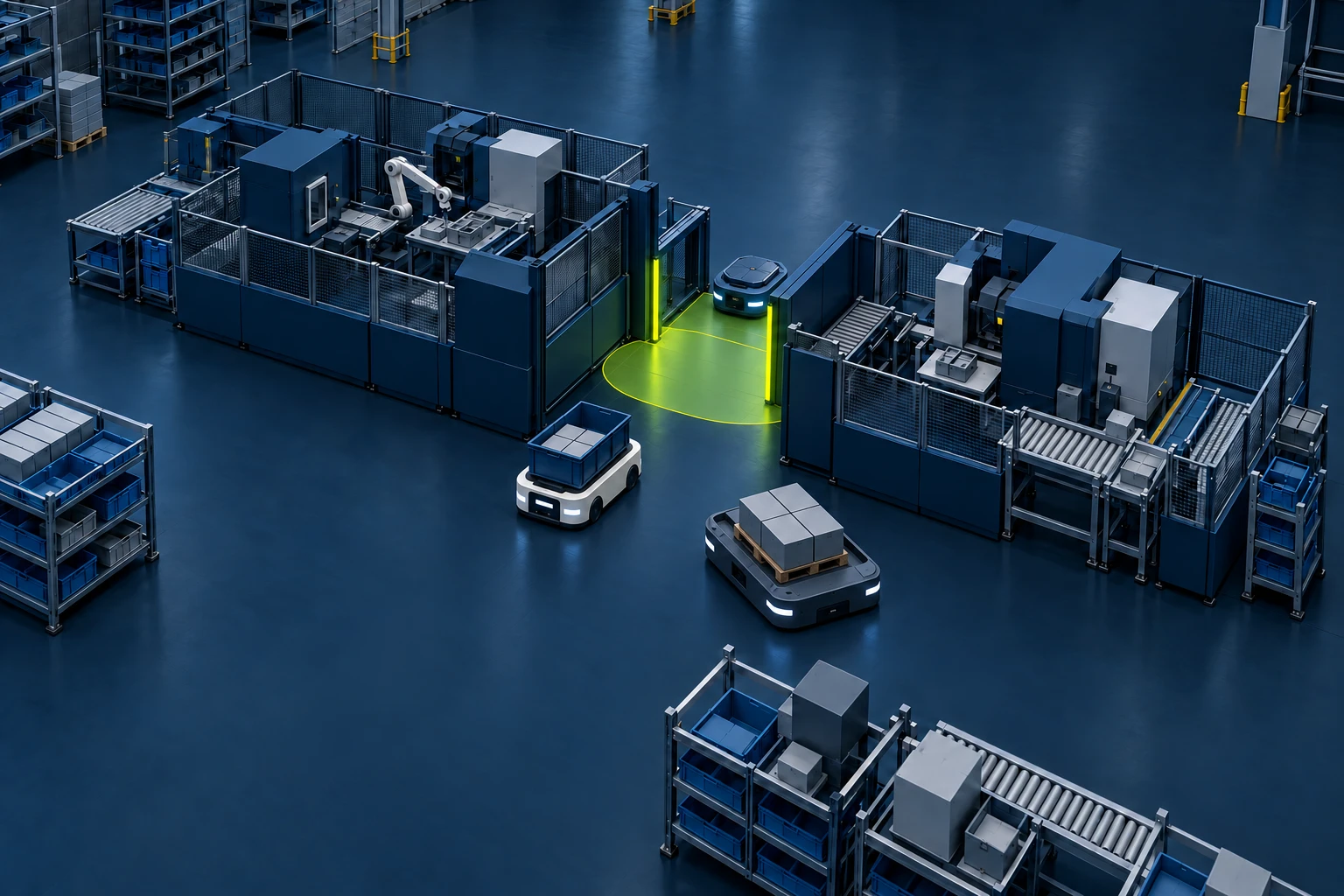
Illustration: Several mobile robots wait in front of the entrance to a production cell
Why are these robots waiting?
LORIopenmaind's AI
Three robots are waiting at the entrance of the production cell because a transport is occupying the access. I recommend spreading the deliveries out in time – shall I prepare a proposal?
Test a layoutTry it
Illustration: A planned new layout shown as a simulation next to the existing material flow
What happens with a new line?
LORIopenmaind's AI
I've simulated the new line: routes to material supply get longer and utilization at the crossing increases. Would you like to compare a variant with an additional robot?

Example of the product concept – no live connection to real robots.

Your starting point matters

Where are you right now?

You don't need robots yet to start with openmaind. And you don't need another island if your fleet is already growing.

01 / The first step

“We want to automate.
But where does it pay off?”

Before you choose a robot, we build a solid basis for your material transport decisions – independent of vendors and manufacturer interests.

  • Identify suitable processes and potential
  • Simulate layouts and scenarios
  • Prepare the first deployment together
Check automation potential →
02 / The next step

“Our robots are running.
Now everything should work together.”

Connect your existing AGV and AMR fleets and make changes in daily operations easier.

  • Coordinate different manufacturers together
  • See orders and bottlenecks in context
  • Adapt processes intuitively to new requirements
See openmaind live →
The interplay makes the difference

More manufacturers.
Less complexity.

Individual fleet controllers organize their own robots. openmaind creates the shared layer for your material flow.

Separate systems
Controller AController BController C
Manufacturer A
Manufacturer B
Manufacturer C

Different interfaces. Separate orders. Changes have to be coordinated across several systems.

With openmaind
openmaind · shared orchestration
Manufacturer A
Manufacturer B
Manufacturer C

One overarching view. Shared coordination. More freedom when expanding your mobile robotics.

Existing systems can be connected through suitable interfaces. Which integration is possible, we check based on your robots and fleet controllers.

One system. Three capabilities.

Plan. Orchestrate. Analyze.

Start where you benefit most today – with a platform that carries your next steps.

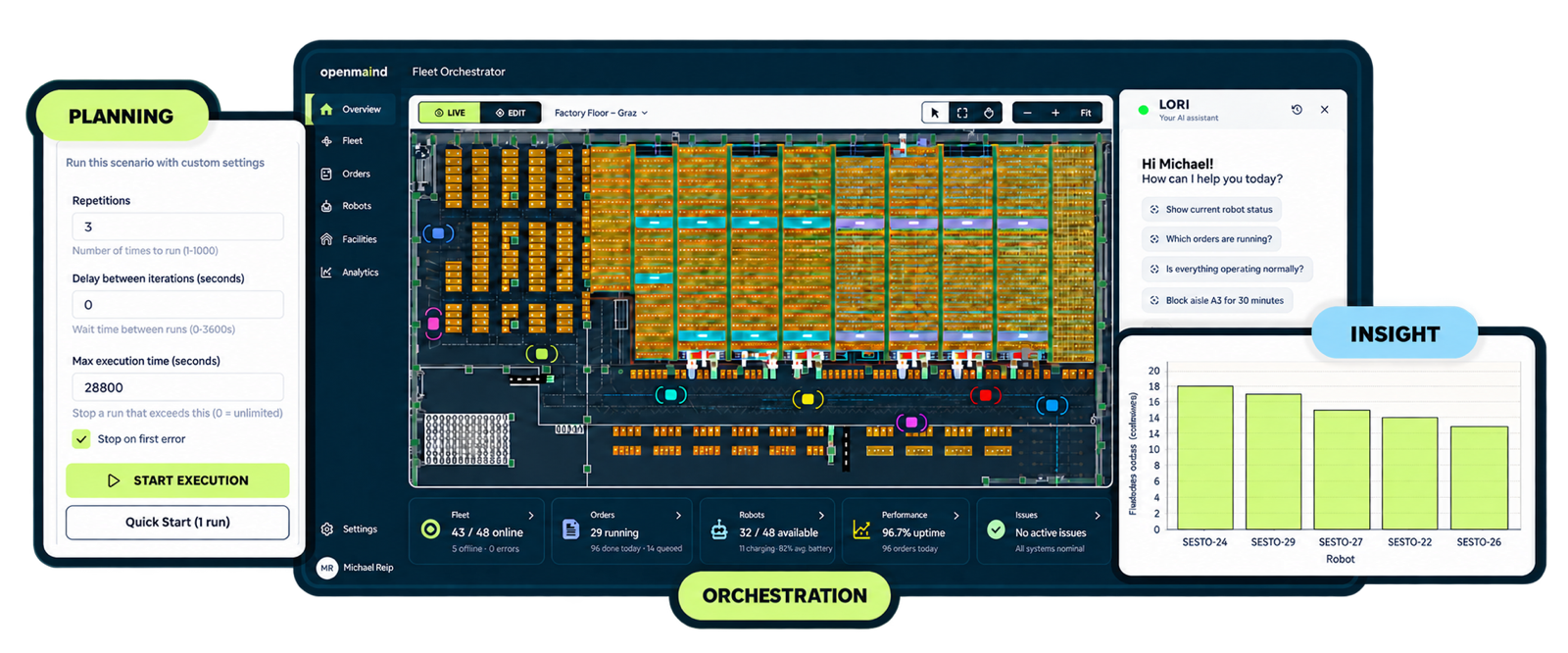
The openmaind fleet orchestrator interface: scenario settings (PLANNING), plant overview with fleet and orders (ORCHESTRATION), analysis by robot (INSIGHT) and the AI assistant LORI
The openmaind fleet orchestrator: scenarios (PLANNING), plant overview (ORCHESTRATION), analytics (INSIGHT) and LORI as AI assistant in one interface.
PLANNING

Simulate first. Then invest.

Check how changed layouts and transport processes could work before you implement decisions on the shop floor.

  • Compare layouts and process variants
  • Examine capacity and vehicle requirements
  • Prepare the first robot deployment on solid ground

Your question: Which scenario fits our plant?

More about PLANNING →
AI that helps in daily operations

A change starts
with your words.

With LORI, a technical task becomes an understandable interaction: ask questions, recognize connections and prepare changes – right in the context of your plant.

“Block this area.”

Prepare a temporary change and check its impact on the material flow.

“Why are these robots waiting?”

Look at orders and traffic situation together to understand bottlenecks better.

“What happens with a new line?”

Simulate a changed layout before you rebuild on the shop floor.

Concrete tasks. Concrete benefit.

What changes in your plant?

01 / Expand

A new manufacturer.
One shared view.

Add to your mobile robotics and check the connection to a shared orchestration, instead of building the next isolated fleet.

02 / Adapt

Your process changes.
Your robotics follow.

New stations, changed transport routes or temporary blockages: prepare adjustments directly in the context of your layout.

03 / Decide

More robots?
Understand first.

Examine bottlenecks and simulate scenarios to put capacity decisions on a traceable foundation.

Who we are

What drives us.

0+
Years of experience
in robotics & AI
0
Successful exit
(Verizon, 2021)
0
Founders with PhDs,
MBA & AMR practice
The openmaind founding team
In 2021, Michael Reip and Christoph Zehentner successfully sold incubed IT – one of the leading AMR software solutions – to Verizon.
"We know from experience which vendor promises hold up in practice – and which don't."
— Michael Reip, CEO & Co-Founder

We believe in data – and even more in good decisions.

We build for real processes – not for perfect slides.

We like clear words and clean systems.

We think long-term, not feature-driven.

We take technology seriously – and ourselves not too seriously.

We want automation to finally be fun and intuitive.

Good to know

The most important
questions first.

So that an interesting idea becomes a clear next decision.

See all questions →
What is a fleet orchestrator?

Software that coordinates mobile robot fleets across vendors. At openmaind, it is about AGVs and AMRs in intralogistics: orders, material flows and different manufacturers come together on one shared layer.

Do we need AGVs or AMRs already?

No. INSIGHT and PLANNING let you start with your existing material transport. We look at the process first and check where mobile robotics can make sense.

Do we have to replace our existing fleet controllers?

That depends on your system landscape. openmaind can work as an overarching layer. Which systems stay and which interfaces are used, we clarify for your specific case.

Which robots can be connected?

Connectivity depends on the available interfaces and capabilities of each system. VDA 5050 is one possible integration path. In a conversation, we check the compatibility of your manufacturers and models.

What does “operating with AI” mean in practice?

You describe a question or a desired change in natural language. LORI supports analysis and preparation in the context of layout and processes. Which actions and approvals are possible is part of the respective setup.

How does a project start?

With your starting situation: processes, layout and – if available – robots and fleet controllers. Together we determine the right entry point, the data needed and a manageable first use case.

The next step is a conversation

Your plant. Your starting point.

Let's find out how mobile robotics can become simpler for you.